Home Office Tax Deductions in 2026: Simplified vs Actual Method
- Who this is for: self-employed people, freelancers, and 1099 contractors who work from home. W-2 employees do not qualify for the federal deduction.
- What qualifies: a space used regularly and exclusively for business that is your principal place of business.
- How to claim it: compare the simplified method ($5 per square foot, max $1,500) against the actual expense method (business-use percentage of real costs on Form 8829), then take the larger.
The home office deduction is one of the most valuable and most misunderstood write-offs available to remote workers. The single fact that decides everything is your employment status: self-employed people get a generous deduction, while W-2 employees generally get nothing at the federal level. This guide walks through who qualifies, the two calculation methods, and the exact figures that apply for the 2026 tax year. Before you draft anything, you can size your deduction in under a minute with our home office tax deduction calculator.
In this article

Who qualifies for the home office deduction?
The home office deduction is a write-off for the business use of your home, available only to taxpayers who report self-employment income. Eligibility turns entirely on whether you file a Schedule C (or report farm or partnership income) rather than a W-2.
If you are a freelancer, independent contractor, consultant, sole proprietor, or single-member LLC, you can claim the deduction. If you are a W-2 employee, you cannot, even when your employer requires you to work from home. The Tax Cuts and Jobs Act (TCJA) suspended the unreimbursed employee expense deduction beginning in 2018, and subsequent legislation made that change permanent. For the full W-2 versus 1099 framing, including which states still allow an employee deduction, see our companion guide on remote work tax deductions.
Q: I have a W-2 job and a freelance side gig. Can I deduct a home office?
Yes, but only against the freelance income. If you use a dedicated space regularly and exclusively for the side business, you claim the deduction on Schedule C for that business only. It cannot offset your W-2 wages, and it generally cannot create a Schedule C loss.
What is the regular and exclusive use test?
The regular and exclusive use test is the IRS rule that the deducted space must be used both routinely for business and for nothing else. Per IRS Publication 587, the space must clear two bars:
- Regular and exclusive use. A spare bedroom used only as an office qualifies. A dining table you also eat dinner at does not. The space does not have to be an entire room, but the portion you claim must be used solely for business.
- Principal place of business. The home office must be your principal place of business or a place where you regularly meet clients. For most full-time remote freelancers this is automatic.
There are two narrow exceptions to exclusive use: space used for storing inventory or product samples, and space used as a licensed daycare facility. Outside those, exclusivity is non-negotiable.
How does the simplified method work?
The simplified method is a flat-rate shortcut that lets you skip expense tracking and depreciation. The IRS lets you deduct $5 per square foot of home office space, up to 300 square feetverified 2026-05-29, for a maximum deduction of $1,500 per yearverified 2026-05-29[1].
- No need to track actual home expenses
- No depreciation calculation and no future depreciation recapture
- Measure your office, multiply by $5, cap at 300 square feet
- Claimed directly on Schedule C, Line 30, no Form 8829 required
How does the actual expense method work?
The actual expense method calculates your deduction as the business-use percentage of your real home costs, reported on IRS Form 8829. The business-use percentage is your office square footage divided by your total home square footage.
Formula: (office square footage / total home square footage) × eligible home expenses = deduction.
Example: a 200 square foot office in a 1,500 square foot apartment is a 13.3% business-use percentage. You can deduct 13.3% of:
| Expense | Deductible portion |
|---|---|
| Rent (or mortgage interest, not principal) | Business-use % |
| Property taxes | Business-use % |
| Utilities (electric, gas, water) | Business-use % |
| Renter's or homeowner's insurance | Business-use % |
| Internet service | Business-use % of work-related share |
| General home repairs and maintenance | Business-use % |
| Office-only repairs (painting the office) | 100% |
| Depreciation (homeowners) | Business portion over 39 years |
For self-employed remote workers in high-cost cities, the actual expense method frequently yields a deduction in the $3,000 to $8,000 range, far above the $1,500 simplified cap. The tradeoff is recordkeeping plus, for homeowners, depreciation recapture taxed at up to 25% when you sell. Freelancers who want help structuring this cleanly will find deeper mechanics in our friends at CeoCult's deductions-by-profession guide.
Which method should you choose?
The right method is simply whichever produces the larger deduction for your situation, weighed against recordkeeping effort. The decision comes down to office size, housing cost, and whether you own your home.
| Factor | Simplified method | Actual expense method |
|---|---|---|
| Maximum deduction | $1,500 (300 sq ft cap) | No fixed cap; scales with costs |
| Recordkeeping | Minimal | Detailed expense logs |
| Form required | Schedule C, Line 30 | Form 8829 |
| Depreciation | None | Yes (homeowners) |
| Recapture on home sale | None | Up to 25% on depreciation taken |
| Best for | Small office, low housing cost, renters who value simplicity | Large office, high rent or mortgage, expensive metros |
Q: Can I switch methods from year to year?
Yes. You can use the simplified method one year and the actual method the next, choosing whichever is larger. The only catch for homeowners is that switching does not let you recover depreciation you skipped during simplified-method years, so model the multi-year picture before you sell.
Can you deduct equipment separately?
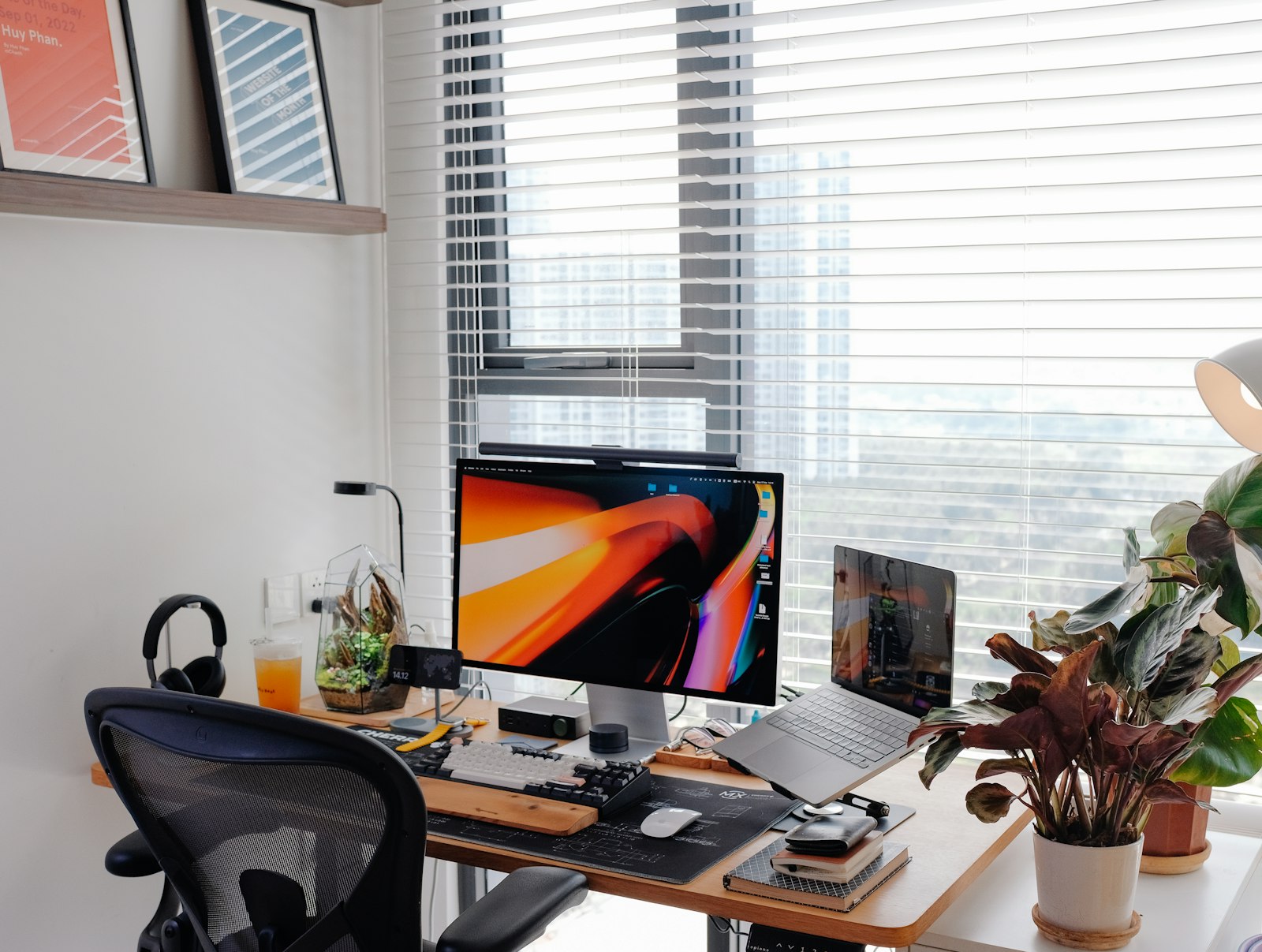
Yes. The home office deduction covers the space itself; the desk, chair, monitor, and other gear are separate business expenses deducted on their own. For self-employed workers, three rules let you expense most equipment in full the year you buy it.
Section 179. Section 179 lets you immediately expense qualifying equipment instead of depreciating it over years. For 2026 the Section 179 cap is $2,560,000verified 2026-05-29, with the phaseout beginning at $4,090,000 of property placed in service[2]. No home-office worker will approach that ceiling, so in practice your full equipment purchase is expensable in year one.
100% bonus depreciation. The One Big Beautiful Bill Act (OBBBA) restored 100% first-year bonus depreciation and made it permanent for qualifying property placed in service in 2026 and after[3]. This reverses the phasedown that had dropped bonus depreciation to 40% in 2025, so a computer or standing desk bought in 2026 can be fully written off immediately.
De minimis safe harbor. For items costing $2,500 or less per item or invoice, you can elect the de minimis safe harbor and expense them without tracking depreciation at all. That covers nearly every individual office purchase: monitors, keyboards, webcams, desk accessories.
Planning a deductible workspace is the cheapest tax move you can make, because you would buy the gear anyway. Our best standing desks guide covers options from roughly $200 to $699, and our ergonomic chair guide runs from $299 to $1,395. If you are expensing the chair through a company rather than buying it personally, the certified contract-grade tier is the one built to survive a substantiation review: the Haworth Fern publishes BIFMA and GREENGUARD Gold certification with a 12-year warranty, from about $1,000. The full home office setup guide helps you plan a workspace that maximizes both productivity and deductible square footage.
Size your deduction before you file
Enter your office square footage and home costs to see whether the simplified or actual method gives you more, in under a minute.
Run my deduction estimate →What mistakes cost remote workers money?
The most expensive errors are not aggressive deductions; they are missed ones and disqualifying habits. Four show up repeatedly.
1. Assuming W-2 employees can claim it
Tax software may ask if you have a home office. If you are a W-2 employee, answering yes for a federal deduction is wrong under current law and can invite scrutiny. Pursue employer reimbursement or a state-level deduction instead.
2. Letting the office double as personal space
Exclusive use is binary. A desk in the corner of a den you watch TV in does not qualify. The fix is a genuinely dedicated space, even a small one.
3. Reconstructing expenses at filing time
Trying to rebuild a year of utility and rent records in April invites errors. Track expenses as they happen with bookkeeping software; our friends at CeoCult compare options in their bookkeeping apps for freelancers roundup.
4. Ignoring depreciation recapture before a home sale
Homeowners who took the actual method and claimed depreciation owe recapture tax (up to 25%) on that depreciation when they sell. This is why some homeowners prefer the simplified method even when actual would deduct more annually. Decide with a CPA before listing the home.
- Primary sources
- IRS Publication 587, Form 8829, Rev. Proc. 2013-13, and OBBBA depreciation provisions
- Figures verified
- $5/sq ft simplified rate, $1,500 cap, $2,560,000 Section 179 limit, 100% bonus depreciation, all verified May 2026
- Scope
- Federal rules for self-employed and 1099 filers; state rules summarized only
- Reviewed by
- Vincent Couey, founder DeskDeploy
- Conflicts
- Educational content; no tax-preparation affiliate relationships influence the figures above
- Last verified
- May 2026
Get the home office deduction worksheet
A one-page worksheet that walks you through both methods and the records you need to defend the deduction.
Can W-2 employees claim the home office deduction in 2026?
Is the simplified or actual method better?
What is the regular and exclusive use test?
Can I deduct a standing desk and chair with the home office deduction?
Does the home office deduction trigger an audit?
Bottom line
If you are self-employed, the home office deduction is real money: measure your space, run both the simplified ($5 per square foot, max $1,500) and actual methods, and take the larger. Expense your gear separately using Section 179, the restored 100% bonus depreciation, or the de minimis safe harbor. If you are a W-2 employee, the federal deduction is off the table, so pursue reimbursement or a state deduction. Whatever your status, track expenses all year, not in April.
- Internal Revenue Service. Simplified Option for Home Office Deduction (Rev. Proc. 2013-13). irs.gov verified 2026-05-29 return
- Internal Revenue Service / inflation-adjusted Section 179 limits for tax year 2026. irs.gov Publication 946 verified 2026-05-29 return
- One Big Beautiful Bill Act, 100% bonus depreciation under IRC 168(k), property placed in service in 2026. irs.gov newsroom verified 2026-05-29 return